
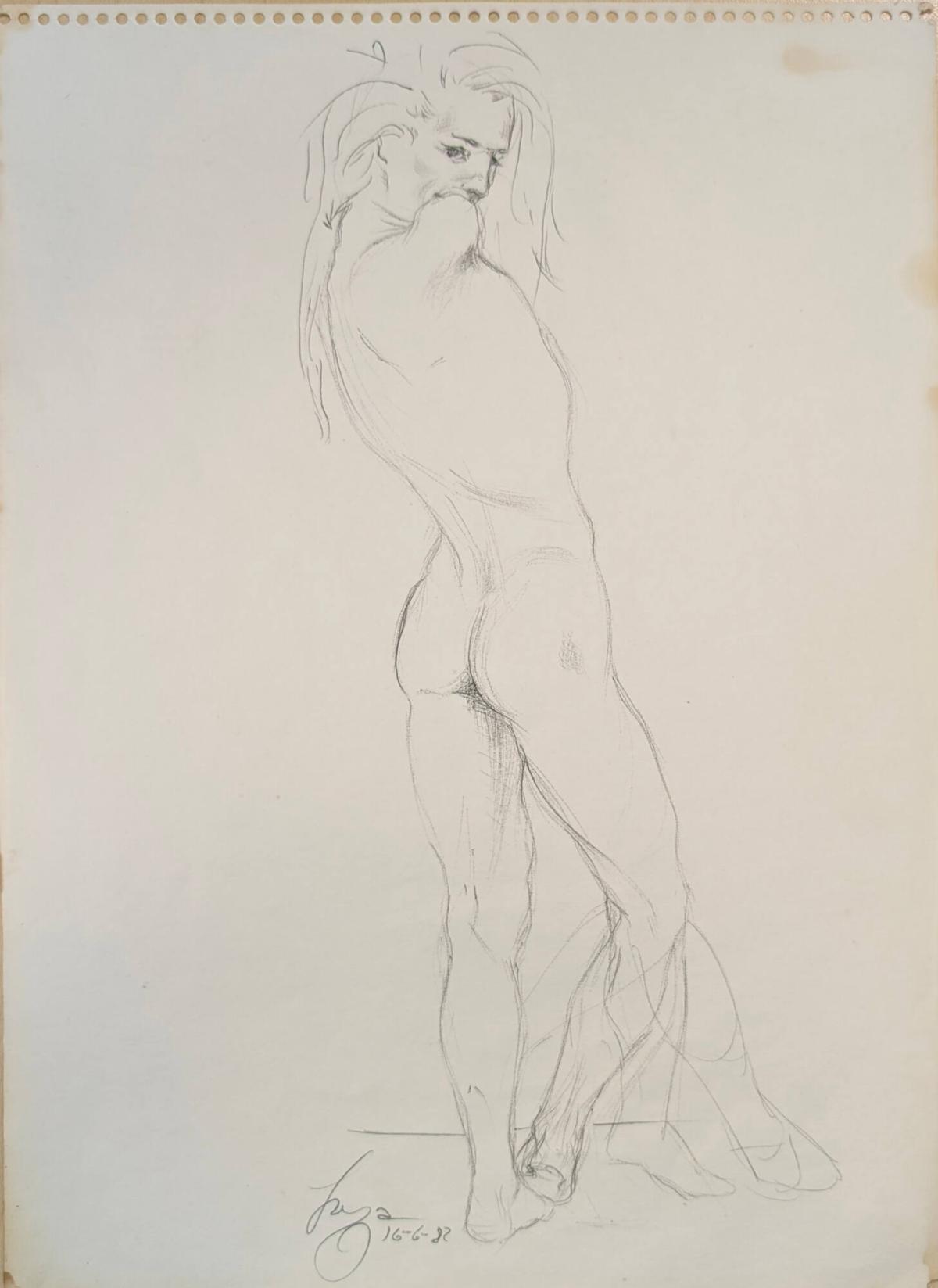
Untitled
Artist/Maker
Lorenza Böttner
(Chilean-German, 1959 –1994)
Date1982
MediumPencil on paper
DimensionsImage/Sheet: 12 15/16 × 9 3/8 in. (32.9 × 23.8 cm)
Credit LineRuth C. Roush Fund for Contemporary Art and with funds provided by Dominique H. Vasseur (OC 1973)
Object number2025.18
Status
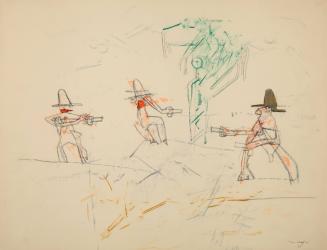
Not on viewThis intimate self-portrait encompasses Lorenza Böttner’s practice as a visual artist, dancer, performer, and mouth-and-foot painter. The artist chose a posture that reveals parts of her face and body–notably with a range of movement in her lower right leg–and also conceals a frontal view of her nude body. Working in drawing, painting, and photography, the artist used the self-portrait genre to explore the fluid boundary between masculinity and femininity with art historical rigor and humor. In some works she makes reference to Frida Kahlo’s self-portraits, Sandro Botticelli's Birth of Venus, and the Venus de Milo, while in others she emulates Tom of Finland's erotic style of illustration.
Born in Punta Arenas, Chile to German parents, the artist received an electric shock at age eight while climbing a pylon and both of her arms were amputated as a result of the injuries she sustained. Soon after moving to Germany with her mother at age fourteen, Böttner adopted female dress and began to inhabit a transgender identity. She intentionally declined the prosthetic options available to her, insisting on the beauty of her body as it was. Böttner said, "I saw how many statues were admired for their beauty, and through an accident or something, they too have lost their arms, but they have lost nothing of their beauty or their aesthetic appeal." She considered gender affirmation surgery but ultimately decided against that too, preferring “to be accepted in my extreme way.”
Böttner studied classical ballet, jazz, and tap dance and, as a painting student in Kassel, wrote a thesis titled Behindert? (“Disabled?”) arguing that mouth-and-foot painters need not be understood as “disabled.” She performed the act of painting in streets, LGBTQ+ nightclubs, and public squares, spreading canvases on the ground and dancing on top of them with brushes clenched in her toes. She moved to Barcelona in 1988 and died six years later of AIDS-related illness. Solo presentations at documenta 14, Kassel, Germany (2017) and the Leslie Lohman Museum, New York (2022) brought renewed attention to Böttner’s work.
Born in Punta Arenas, Chile to German parents, the artist received an electric shock at age eight while climbing a pylon and both of her arms were amputated as a result of the injuries she sustained. Soon after moving to Germany with her mother at age fourteen, Böttner adopted female dress and began to inhabit a transgender identity. She intentionally declined the prosthetic options available to her, insisting on the beauty of her body as it was. Böttner said, "I saw how many statues were admired for their beauty, and through an accident or something, they too have lost their arms, but they have lost nothing of their beauty or their aesthetic appeal." She considered gender affirmation surgery but ultimately decided against that too, preferring “to be accepted in my extreme way.”
Böttner studied classical ballet, jazz, and tap dance and, as a painting student in Kassel, wrote a thesis titled Behindert? (“Disabled?”) arguing that mouth-and-foot painters need not be understood as “disabled.” She performed the act of painting in streets, LGBTQ+ nightclubs, and public squares, spreading canvases on the ground and dancing on top of them with brushes clenched in her toes. She moved to Barcelona in 1988 and died six years later of AIDS-related illness. Solo presentations at documenta 14, Kassel, Germany (2017) and the Leslie Lohman Museum, New York (2022) brought renewed attention to Böttner’s work.
The AMAM continually researches its collection and updates its records with new findings.
We welcome additional information and suggestions for improvement. Please email us at AMAMcurator@oberlin.edu.
We welcome additional information and suggestions for improvement. Please email us at AMAMcurator@oberlin.edu.
1948
1977
1959
ca. 1962
1962
1962